Robotic Spine Surgery
Advanced Spine Care
Robotic precision. Human expertise. Smarter spine surgery.
Robotic spine surgery combines advanced 3D imaging, computer-assisted planning and robotic guidance with the surgeon’s expertise — helping plan and execute complex spinal procedures with greater precision, consistency and control.
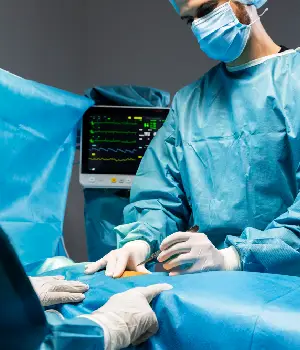
What it is
A more precise way to plan and place.
Traditional spine surgery depends heavily on the surgeon’s experience and conventional imaging to determine the position and trajectory of implants. Robotic-assisted surgery adds detailed 3D planning and real-time guidance to help the surgeon execute that plan with precision.
Before surgery, your CT and other imaging data can be used to create a personalised 3D surgical plan. During the procedure, the robotic platform helps guide instrument and implant placement according to the planned trajectory — while the surgeon remains fully in control.
The goal is not to replace the surgeon. It is to give the surgeon better information, greater precision and an additional layer of control when performing complex spinal procedures.
Conditions we treat
When precision matters,
Robotic guidance can make a difference
Robotic-assisted spine surgery may be considered for selected conditions requiring accurate instrumentation or spinal stabilisation, including:
- Spondylolisthesis
- Spinal Instability
- Degenerative Spine Disease
- Lumbar Canal Stenosis
- Spinal Deformities
- Scoliosis
- Complex Spine Surgery
- Selected Spinal Fractures
Areas of Practice
The full spectrum of
modern robotic spine care.
Advanced imaging, computer-assisted planning and robotic guidance — combined with surgical expertise and selected according to each patient’s anatomy and condition.
01
Robotic-Assisted Spine Surgery
Computer-guided precision for accurate spinal instrumentation and stabilisation.
02
3D Surgical Planning
A personalised surgical roadmap built from detailed imaging of your spine.
03
Pedicle Screw Placement
Robotic guidance helps the surgeon follow planned trajectories for accurate implant positioning.
04
Spinal Deformity Surgery
Advanced planning and navigation for complex deformities such as scoliosis and kyphosis.
05
Complex & Revision Spine
Technology-assisted planning for challenging anatomy and previously operated spines.
06
Minimally Invasive & Robotic Techniques
Combining robotic guidance with minimally invasive approaches where clinically appropriate.
Appointments
Where I’ve practised.
Step 01
Consultation & planning
Clinical examination, MRI/CT review and detailed assessment of your spine. If robotic surgery is appropriate, your imaging is used to create a personalised surgical plan.
Step 02
3D surgical planning
Your spinal anatomy is reconstructed digitally to help determine implant size, position and optimal trajectories before entering the operating room.
Step 03
Robotic-assisted procedure
During surgery, the robotic system provides guidance based on the preoperative plan. The surgeon controls every surgical step while using real-time information to improve accuracy.
Step 04
Early recovery
After surgery, you are monitored and mobilised according to the procedure performed and your individual recovery. Physiotherapy may begin early when appropriate.
Step 05
Back to life
Your recovery plan is tailored to the surgery performed, your spinal condition and your goals — with follow-up to monitor healing, mobility and long-term function.
Frequently asked
The questions patients
ask us most
Don’t see yours? Bring it to the consultation — the honest answer is part of the plan.
No. The surgeon remains in control throughout the procedure. The robotic system provides planning, guidance and precision assistance during selected surgical steps.
Robotic technology can improve planning and assist with accurate implant placement in appropriately selected procedures. Whether it offers a meaningful advantage depends on the condition, procedure and individual anatomy.
Not every spine problem requires robotic assistance. Your symptoms, imaging, spinal anatomy and the type of surgery required determine whether robotic technology is appropriate.
Robotic assistance and minimally invasive surgery are different concepts. Robotic technology can be used alongside minimally invasive techniques in selected procedures, but not every robotic spine surgery is minimally invasive.
Recovery depends primarily on the condition being treated and the type and extent of surgery. Robotic guidance may support minimally invasive approaches in suitable cases, but it does not guarantee a faster recovery.
Robotic systems are designed to assist with surgical planning and precision. As with any spine surgery, safety depends on careful patient selection, appropriate planning and experienced surgical care.
Take the next step
Need precision for a complex spine problem?
Bring your MRI or CT scans for a clear, unhurried opinion on whether robotic-assisted spine surgery is right for you.