Minimally Invasive Spine
Advanced Spine Care
The smallest possible surgery. The fastest recovery.
Minimally invasive spine surgery (MISS) replaces long open cuts with keyhole incisions, precision tubes and image guidance — so the spine is fixed without disturbing the muscle, blood and nerves around it.
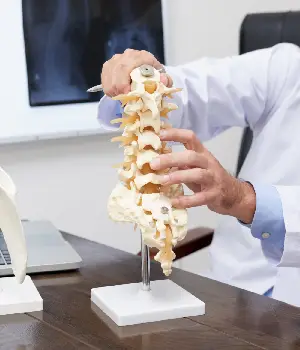
What it is
A different way
to reach the spine.
Traditional open spine surgery relies on a long incision and pulling muscle away from the vertebrae to expose the problem. It works — but the collateral damage is real: bleeding, longer hospital stays and weeks of stiffness.
MIS uses small ports, live imaging and specialised instruments to treat exactly the pathology and leave the rest of your back alone. The disc, nerve or fracture is addressed with millimetric precision — often through an opening no wider than a fingertip.
The result is not just a smaller scar. It is faster mobilisation, less painkiller dependence, and a genuine return to work and life measured in days, not months.
Conditions we treat
If it hurts here,
we can probably help.
Most spine problems that once needed open surgery are today handled through a keyhole. A few of the common ones:
- Slipped / Herniated Disc
- Lumbar Canal Stenosis
- Osteoporotic fractures
- Sciatica
- Cervical Radiculopathy
- Spondylolisthesis
- Recurrent Disc Prolapse
- Failed Back Surgery Pain
Areas of Practice
The full spectrum of
modern spine care.
Built around minimally invasive, endoscopic and robotic techniques — chosen case by case, not by habit.
01
Minimally Invasive & Robotic
Precision spine surgery with smaller incisions, faster recovery.
02
Endoscopic Spine Surgery
Day-care procedures through millimetre-scale ports.
03
Degenerative Spine
Disc, canal stenosis, spondylolisthesis & instability.
04
Spine Deformity & Corrective Surgery
Scoliosis, kyphosis and high-grade listhesis — hybrid techniques refined over hundreds of cases.
05
Spine Infection & Tumours
Coordinated, multi-disciplinary care for complex pathology with rapid neurological recovery.
06
Osteoporotic Fractures
Percutaneous stabilisation and vertebroplasty for the elderly, restoring mobility in days, not weeks.
Appointments
Where I’ve practised.
Step 01
Consultation & planning
Clinical exam, MRI review and an honest conversation about whether surgery is even the right answer for you.
Step 02
Keyhole procedure
45–90 minutes in most cases. Spinal or general anaesthesia. You'll wake up in a normal ward, not the ICU.
Step 03
On your feet
Physiotherapist gets you walking the same evening or the next morning. Most patients go home in a day.
Step 04
Home recovery
Light walking, gradual return to desk work. No brace for most procedures. Painkillers taper off quickly.
Step 05
Back to life
Driving, travel and normal routine. A follow-up scan confirms healing; a structured exercise plan protects the spine long-term.
Frequently asked
The questions patients
ask us most
Don’t see yours? Bring it to the consultation — the honest answer is part of the plan.
For the right indication, yes — outcomes at one year are equal or better in most published studies, with significantly less short-term pain and disability.
Most degenerative disc, nerve compression and single-level instability problems qualify. Complex deformity or extensive fusions may still need an open or hybrid approach — we’ll tell you honestly which one is right for you.
Desk work: 1–2 weeks. Field or physical work: 4–6 weeks. Every plan is tailored around what your day actually looks like.
You’ll have one or two small marks that fade over months. Endoscopic incisions are often invisible within a year.
No. Many conditions improve with physiotherapy, medication and lifestyle changes. Surgery is offered only when conservative care has failed or the condition is urgent.
It depends on the diagnosis, imaging and your overall health. Dr. Patel will explain whether endoscopic, tubular, robotic-assisted or a hybrid approach is most suitable.
Take the next step
Still living with back pain?
Bring your MRI report for a clear, unhurried opinion on whether minimally invasive surgery is right for you.