Endoscopic Spine Surgery
Advanced Spine Care
Precision spine surgery. Through the smallest possible opening.
Endoscopic spine surgery uses a high-definition camera, millimetre-scale access ports and specialised instruments to treat spinal problems through tiny incisions — minimising muscle disruption while targeting the source of pain with precision.
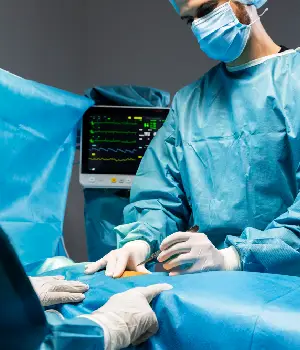
What it is
A clearer way to reach the spine.
Traditional spine surgery may require larger incisions and significant muscle dissection to access the affected area. Endoscopic surgery takes a different route — using a small working channel and a camera to reach the disc, nerve or other pathology directly.
A high-definition endoscope provides a magnified view of the surgical field, while specialised instruments allow the surgeon to remove or treat the problem through an opening that may be only a few millimetres wide.
The goal is not simply a smaller scar. Less disruption to surrounding muscles and tissues can mean less postoperative pain, earlier mobilisation and a faster return to everyday activities — when the patient and condition are suitable for an endoscopic approach.
Conditions we treat
If it hurts here,
Endoscopy may be an option.
Endoscopic spine surgery can be used for selected spinal conditions, including:
- Slipped / Herniated Disc
- Lumbar Canal Stenosis
- Cervical Radiculopathy
- Sciatica
- Degenerative Spine
- Nerve Compression
- Recurrent Disc Prolapse
- Foraminal Stenosis
Areas of Practice
The full spectrum of
modern endoscopic spine care.
Endoscopic techniques are selected case by case — based on the location of the problem, spinal anatomy, imaging findings and your overall condition.
01
Endoscopic Discectomy
Targeted removal of herniated disc material through a tiny access port.
02
Endoscopic Decompression
Relieving pressure on compressed spinal nerves while minimising disruption to surrounding tissues.
03
Endoscopic Spine Surgery
Advanced camera-assisted techniques for selected lumbar and cervical spine conditions.
04
Degenerative Spine
Treatment planning for disc disease, stenosis, foraminal narrowing and nerve compression.
05
Recurrent Disc Prolapse
Minimally disruptive approaches for selected patients with recurrent disc herniation.
06
Precision & Minimally Invasive Care
Small access, direct visualisation and specialised instruments — chosen according to the individual spinal problem.
Appointments
Where I’ve practised.
Step 01
Consultation & planning
Clinical examination, MRI review and a detailed discussion to determine whether endoscopic spine surgery is appropriate for your condition.
Step 02
Endoscopic procedure
A small incision is used to introduce the endoscope and specialised instruments. The affected disc, bone or tissue is treated under direct visualisation.
Step 03
Early mobilisation
Depending on the procedure and your recovery, you may be able to stand and walk within hours of surgery.
Step 04
Home recovery
Most suitable patients can return home relatively quickly. Light activity is encouraged, with a gradual return to normal movement as advised.
Step 05
Back to life
Return to work, driving, exercise and other activities is guided by your procedure, symptoms and recovery. Follow-up helps ensure the spine continues to recover well.
Frequently asked
The questions patients
ask us most
Don’t see yours? Bring it to the consultation — the honest answer is part of the plan.
For appropriately selected conditions, endoscopic surgery can provide comparable symptom relief while offering the potential benefits of smaller incisions, less tissue disruption and faster recovery. The right technique depends on the individual spinal problem.
Endoscopic surgery is not suitable for every patient. Your symptoms, neurological examination, MRI findings, spinal anatomy and the type and location of the pathology determine whether an endoscopic approach is appropriate.
Recovery varies by procedure and occupation. Many patients can resume light activities relatively quickly, while physically demanding work may require a longer recovery period.
Endoscopic procedures use very small incisions, so the resulting scar is generally much smaller than that of conventional open surgery.
No. Many spine conditions can be managed with medication, physiotherapy, activity modification or other non-surgical treatments. Surgery is considered when symptoms persist, neurological problems develop or imaging confirms a condition that is likely to benefit from surgery.
The approach depends on where the problem is located and what needs to be treated. Your MRI and clinical examination help determine the safest and most effective technique for your spine.
Take the next step
Still living with back or leg pain?
Bring your MRI report for a clear, unhurried opinion on whether endoscopic spine surgery is right for you.